
When a customer complains that the coffee bag broke after just one drop — what's the cause?
6/29/20262 min read
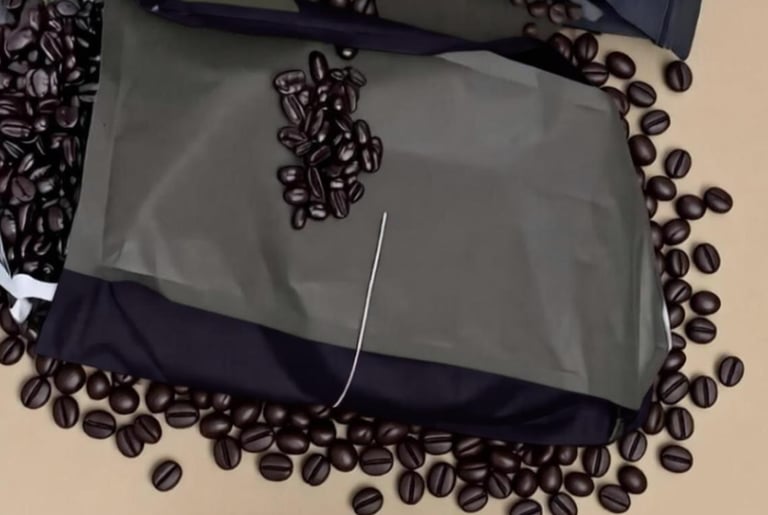
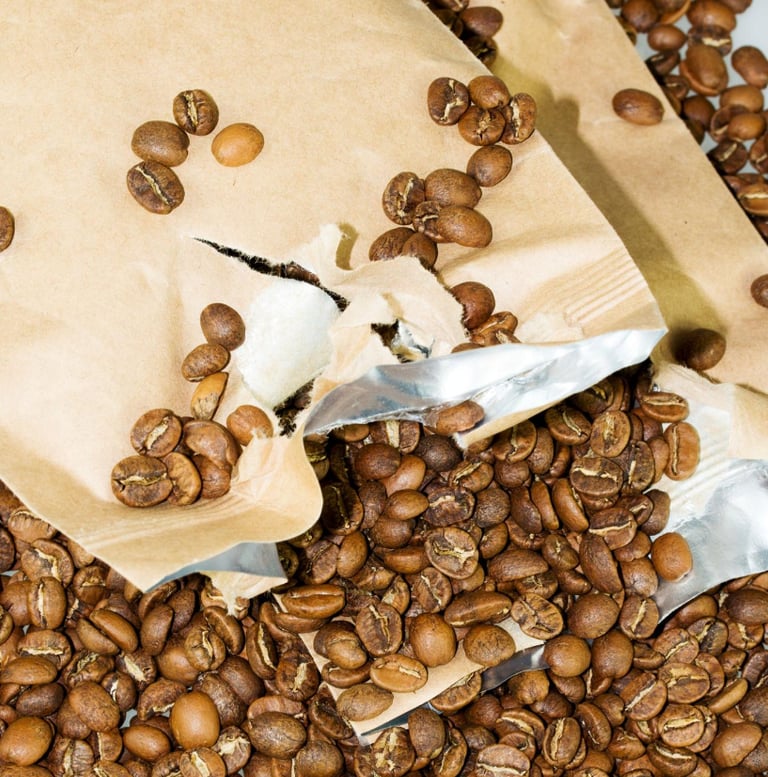
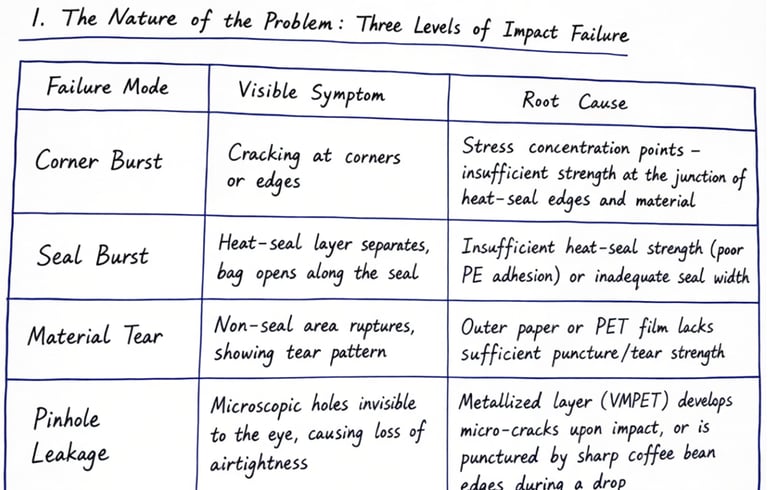
A customer complaint that "the coffee bag broke after just one drop" typically means the packaging fails to meet drop resistance or impact resistance standards. The root cause often isn't simply the "drop" itself, but rather defects in the packaging material, structural design, or sealing process that are exposed under sudden impact.
Here are the specific core reasons:
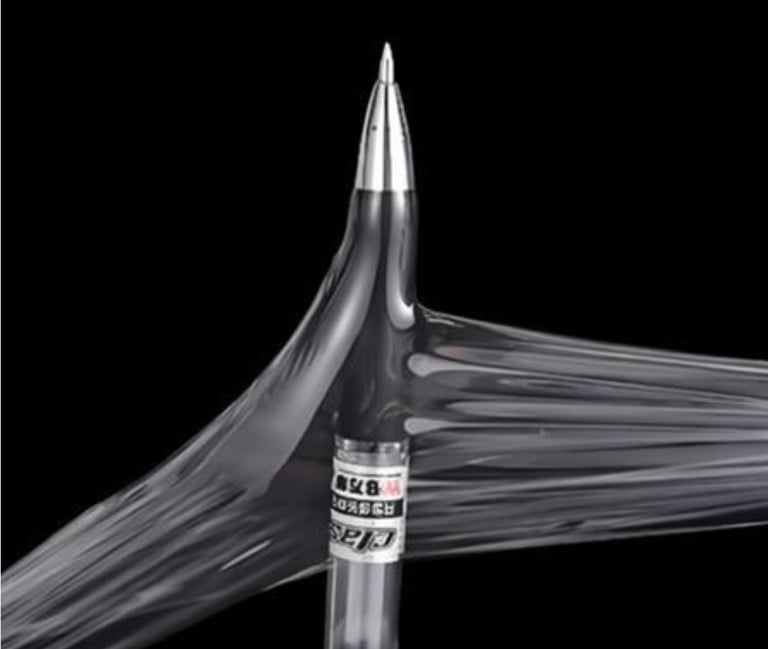
First, insufficient puncture resistance of the packaging material.
What happens: Upon impact, the sharp corners of the coffee beans inside — especially dark roasts, which are harder and more brittle — act like awls, puncturing the packaging from the inside.
Key metric: The film's puncture resistance is too low. Ordinary composite films with puncture resistance below 10N struggle to withstand the impact of bean corners.
Solution: Switch to a material with stronger puncture resistance, such as adding a layer of BOPA (biaxially oriented nylon) to the structure. Nylon's puncture resistance is far superior to standard PET or VMPET (metallized film
Second, insufficient heat seal strength, or embrittlement at the seal area.
What happens: The break occurs precisely along the top or bottom seal line, or on the inner edge of the seal.
Causes:
Excessive sealing temperature or pressure: This "welds" the film too thin and too brittle at the seal, robbing it of flexibility. Upon impact, the force transfers to the stiffest area — the seal — causing it to snap.
Contaminants in the seal: Fine coffee powder gets trapped in the seal, creating a "false seal" that appears secure but has very poor actual strength.
Third, poor drop resistance or pendulum impact resistance of the material.
What happens: After a drop, the bag shows bulges or cracks on the side, or delamination occurs between layers in multi-layer composites like PET/AL/PE.
Causes: The overall packaging lacks sufficient toughness to absorb energy under sudden impact. Common issues include: the material being too hard and brittle (e.g., an overly thick metallized layer); low interlayer peel strength, causing different layers (such as the print layer and seal layer) to separate upon impact; or the material becoming brittle in low-temperature environments (e.g., winter or cold storage).
Fourth, unreasonable bag structure or dimensional design.
What happens: After a drop, the break always occurs at a fixed spot — for example, the bottom corner seal.
Cause: In gusseted bags (bags with folded sides), the folded corners create internal stress or micro-cracks after repeated folding. Upon impact, the force concentrates at these weakest points, leading to failure.
Coffee Packaging Manufacturer
We specialize in manufacturing high-quality coffee packaging bags including stand up pouches, flat bottom bags, and recyclable coffee bags for coffee brands worldwide.
Request a Quote
© 2026 LX Packaging (huizhou) Co., Ltd All rights reserved.